May 19, 2026
Size tiers and the gram budget: reading a plush line from 9 to 29 centimetres
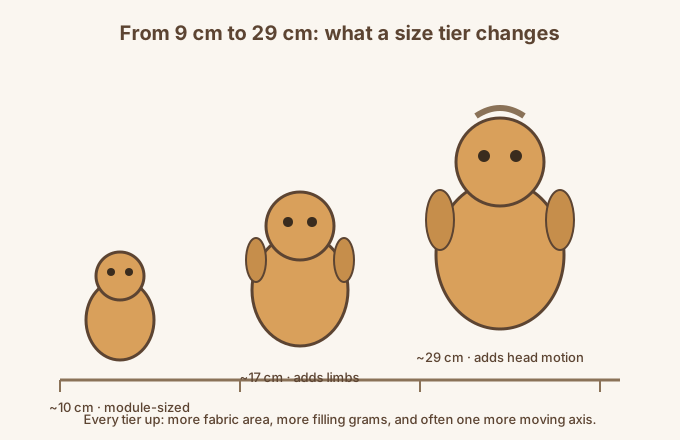
A plush programme rarely ships in one size. Lines span roughly 9 to 29 centimetres, and each tier is a different manufacturing object wearing the same character.
What the size number actually scales
Going from 10 to 17 centimetres does not add 70% of anything — surface area roughly doubles, and filling grams more than double. At 10 cm, a plush is mostly head: eyes, ears and one seam family. At 17 cm, limbs and tail enter, each bringing gussets, pads and a second or third fabric direction. At 29 cm, the body is large enough to carry head motion, weighted bottoms, or a screen module with real structure around it.
The gram budget drives the feel
Filling weight is the feel parameter buyers never see on a spec sheet. Under-filled large plush reads as limp; over-filled small plush reads as a brick. We quote a gram range per tier and validate it with a hanged sample before the line is committed, because the same filling spec that makes a 17 cm toy springy makes a 10 cm toy hard.
Size also decides the electronics tier
A 10 cm body fits only the smallest voice module, and only if the battery is placed as ballast. 17 cm starts to fit speakers with real enclosure space. 29 cm accepts screens and head-gimbal mechanisms. Clients who pick the character size before the interaction tier often discover the two disagree — the character cannot hold the module that sells it.
Quoting rule of thumb
Size drives fabric consumption, filling grams, sewing minutes and packaging volume in that order. It is the first parameter we ask for, because three of the four cost buckets follow from it.